Showing posts with label off the grid. Show all posts

Wednesday, November 12, 2014

 Turn Your Yard Waste Into Fuel With a Wood Gas Generator

wood gasificationAt some point you've probably seen one of those post apocalyptic movies like Mad Max, or the more recent Walking Dead series. Do you ever wonder how, after so many years after the apocalypse, their vehicles are somehow still running? And I'm not just talking about maintenance and replacement parts. The gasoline alone would pose a serious problem, and most fossil fuels would be completely used up long before you have to get an oil change.

Not to mention the fact that gasoline has a rather short expiration date. The most common estimate I've heard, is that gasoline begins to degrade after 3 to 6 months. That's not to say that there wouldn't be some vehicles still on the road after the grid goes down. They're just not going to be running on gasoline. Instead, they would likely be using wood for fuel.

If you don't know what I'm talking about, it's called wood gasification, and it works by applying heat and pressure to a sealed container filled with organic material like wood, leaves, saw dust, or charcoal. Rather being burned, this process extracts gases like carbon monoxide, methane, and hydrogen from the feedstock, which can then be piped into a combustion engine.

Wood gasifiers became very popular during and after World War Two, when fuel shortages forced people to find creative ways to keep their vehicles running. During the war, over a million wood burning cars were built throughout the world, and half a million were developed in Germany alone. They ran everything from cars to trucks to buses and even tanks. It has the advantage of being fairly energy efficient (definitely more so than burning wood), fuel can be sourced locally, and the ash can be used to fertilize the soil, making it a very self sufficient way to drive around.

However there are a few disadvantages to keep in mind. Wood gas generators are very large and can often weigh several hundred pounds. The feedstock also has a far lower energy density than gasoline or diesel. Typically it takes one pound of wood to travel a mile, whereas a pound of gasoline is about 1/6 of a gallon, and would obviously take you quite a bit further with a modern car.

These vehicles also have trouble accelerating to high speeds, and often take at least 10 minutes to heat up before you can start driving (which would also make Mad Max a pretty boring movie). Despite these drawbacks, wood burning cars would likely be the only way to get most vehicles to run after a major collapse. So how do you build one of these systems?

Well, it's not an easy project to attempt. You'll have to be pretty handy, and might need some welding equipment if you want to make it from scratch. To give you a basic idea of how to build a wood gasifier, take a look at this translated diagram that was widely circulated in Germany during World War Two.
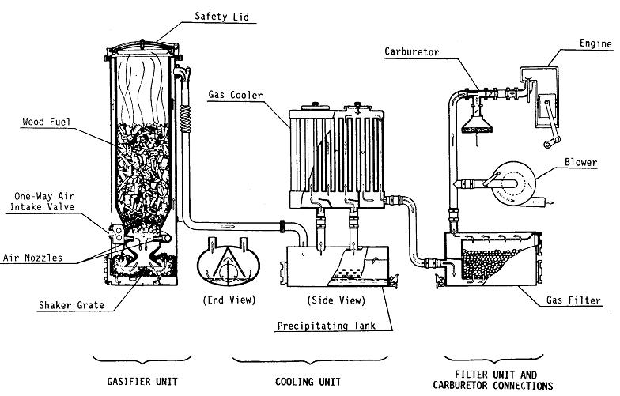
wood gasifier
FEMA also developed a manual for a wood burning car during the late 80's. You can check it out for free here. Or if you're more of a visual learner, you can watch a different gasifier built step by step in this awesome youtube video.


While it may seem like a lot of work for something that you may never end up needing, keep in mind that you can also use hook this system up to a generator. If you have a large property, you probably have a lot of yard waste lying around that could be used to keep your home off the grid.

So if you want to keep your car running after the collapse, do some research on the materials and skills required to build a wood gasifier. Having a running vehicle is a huge advantage during any grid-down scenario, and you'll be one of the lucky few with a working vehicle, long after Mad Max runs out of gas.

Delivered By Ready Nutrition

Tuesday, August 26, 2014

Choosing the Right Batteries for Your Off Grid Retreat

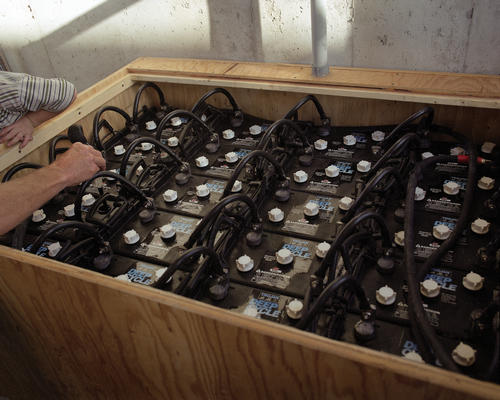
battery bank
When most folks first consider living off the grid, they often find themselves in a little over their heads. Self sufficiency is not something to take lightly, and it requires an extensive knowledge base in multiple fields. You have to take responsibility for services that are far easier to outsource in the city, like food production, energy generation, water supplies, and construction. Once you take a step outside of that system, you're on your own, and you'll have plenty of challenges ahead of you. If there's one thing that will make your life easier, it's a resilient electrical system for your home. And nothing will make your system more convenient or more energy efficient, than a good set of batteries.

Unfortunately, not all batteries are made equal, and the subject of rechargeable batteries can be a little overwhelming at first. Buying the right kind of cell to store your energy is one of the most important decisions you'll make, especially if you plan on relying on solar energy. Many people make the mistake of thinking they can just hook up some old car batteries to their solar panels and call it day. In reality, if you want the benefits of electricity in your home, you'd better have a basic working knowledge of electricity, and the right batteries for the job.

That means you'll most likely need a deep cycle battery. Unlike your car battery, these are designed to discharge large amounts of energy without being damaged , and can be recharged many times without any problems. There are three types of deep cycle batteries that are the most popular for people trying to get off the grid. These include :

Flooded/Wet Cell

Flooded batteries are the more traditional choice for most people, and have been around a lot longer than AGM or Gel batteries. They're significantly cheaper than modern batteries, and can discharge deeper. The only problem is that they need regular maintenance. You'll periodically have to add distilled water to the battery to keep it running, and they must be stored upright to prevent spilling. Flooded Cells emit corrosive gases so they should be kept in a well ventilated environment, and away from sensitive electronics. Despite these issues, they may be the best choice for your budget and situation. As you'll soon see, modern isn't always better.

Gel Cell

Along with AGM, Gel batteries are what's known as "maintenance free". They're sealed in a way that doesn't required you to continuously add water to them. Rather than a liquid acid, the contents of the battery have the consistency of jello, so they will never leak, and there is very little gassing. Like wet cells, they are built for very deep discharges, but are usually the most expensive batteries on the market. The cost will pay off in the long run though. When you look at the price per discharge/recharge cycle, it ends up being the cheaper option for long term daily use.

AGM

While very similar to Gel cells, AGM batteries have their own pro's and cons. They're usually priced between Gel cells and Wet cells, and work better in colder climates than Gel batteries. They're also maintenance free, with no leakage or gassing, and don't need to be stored or used in an upright position. The main drawback, is that they are better suited for lower wattage appliances, whereas Gel cells can have very high discharge rates without being damaged. Typically you don't want draw more than 50 percent of its stored electricity, or it will reduce its lifespan by a large margin.

I would say that, at least initially, most people should purchase a flooded cell battery first. All deep cycle batteries are rather sensitive, and can be easily damaged if they aren't properly charged or maintained. The difference with wet cells, is your ability to add water to them. While AGM's and Gel Cells are known as “Maintenance Free” they should also be known as “Maintenance Proof” because there's no way to open them up and add more fluids. So wet cells have a better 'margin of error' so to speak. If you over charge them to the point of cooking off some of its fluids, it's not the end of the world. You can just add more fluid. Or if you accidentally damage the battery beyond all repair, at least you didn't spend too much money on it. Make your mistakes on wet cells before moving onto the maintenance free batteries.

You'll also have to consider the size of the battery you want. The capacity is always measured in amp-hours, and they either come in 6 or 12 volts. Since you'll want to avoid discharging more than 50 percent of your battery, you'll have to do the math on how much power you expect to generate and use.

Plus, different batteries will be capable of higher discharge rates. This will be crucial when you get around to hooking your appliances up to your battery, because the wattage rating that's listed on most appliances is a little misleading. For instance, say you wanted to run an 800 watt coffee maker. When you first turn it on, it's actually going to run at around 1000 or 1200 watts for a few seconds before it settles into 800 watts. You'll find the same thing with pretty much all appliances. So if you bought a battery that was only capable of providing the listed wattage on your appliances, you'll have trouble getting them to start up.

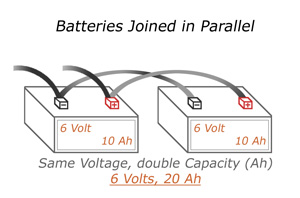
Along with more Amp-hours (Ah), comes more weight. Deep cycle batteries tend to be outrageously heavy. A 100 Ah cell may be the size of an ordinary tool box, but weigh over 60 lbs. If weight is an issue for you, you can buy many smaller batteries and connect them in parallel. This way you can maintain the same voltage, but increase your storage capacity. It should look something like this:
parallel

When it comes to charging the batteries, it would be wise to get a smart charger of some kind. Without that technology, it's very easy to overcharge your batteries and damage them. And once your batteries are ready to be used, you'll need an inverter to convert the DC power of the battery into the AC power of your appliances. As I mentioned before, since the wattage of your appliance can vary significantly, you'll need to buy an inverter that's capable handling the peak wattage of all your appliances.

Finally, if you don't have a multi-meter you should definitely get one. They're not very expensive, and they can be handy in many different applications. In this case, you can use it to measure how much electricity your battery is currently storing. 12 volts is actually a bit of a misnomer when it comes to car batteries and deep cycle cells. When a battery is full, it will actually provide 12.6, or even upwards of 13 volts. A completely drained battery will give out around 10.5 volts before it gives up the ghost. It's kind of like having a bucket full of water and poking a hole in the bottom. The water will come out with less and less force as the bucket empties itself.

Just remember, when you go out to buy your battery, you need something you can rely on above all else. Do your research on the kind of environment you plan on living in, and study up on the different battery options out there. It's a little bit of a daunting subject at first, but well worth it if you plan on going off the grid.

http://www.solar-electric.com/deep-cycle-battery-faq.html
http://solarcraft.net/articles/gel-vs-agm-vs-wet-cell-batteries/
http://trojanbatteryre.com/Tech_Support/ComparingFlood2VRLA.html

Delivered By Ready Nutrition